Abahsikua: A Bold, Craft-Ready Stencil Typeface
If you’ve ever cut vinyl for a farmhouse-style candle label, designed a wedding welcome board that stops guests mid-step, or printed boutique tags with just the right blend of rugged charm and polish—you know how much weight a single font carries. That’s why Abahsikua landed on my worktable and hasn’t left. It’s not just another display font—it’s a stencil typeface built for makers who need clarity, character, and commercial reliability in equal measure.
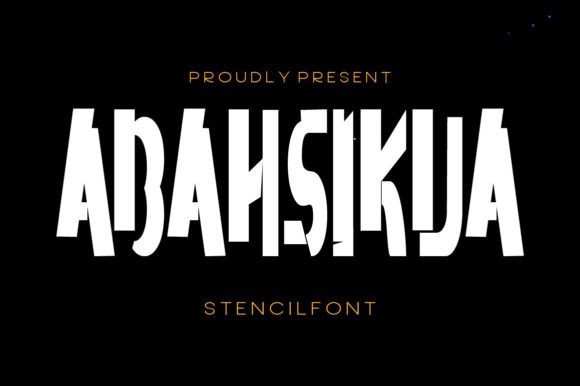
Visually, Abahsikua balances industrial honesty with thoughtful design. Its clean, open letterforms have subtle geometry—tight spacing, consistent stroke weight, and confident angles—that read beautifully at both 12pt (on a tiny sticker) and 120pt (on a wooden sign). Unlike some stencil fonts that feel cold or overly mechanical, Abahsikua carries warmth in its proportions and rhythm. The “A,” “R,” and “S” have quiet personality without sacrificing legibility—a rare win when your font needs to survive Cricut cutting, screen printing, or small-format thermal labels.
I reach for Abahsikua most often when I need instant recognition and quiet authority. Think: hand-poured soy candle jars labeled “Lavender & Sage” in crisp white vinyl against matte kraft paper. Or rustic wedding stationery where “Mr. & Mrs.” appears on a linen napkin tag—not fussy, not fragile, but unmistakably intentional. It works just as well on seasonal product packaging: a holiday hot cocoa mix bag with “Spiced Cocoa Blend” in bold Abahsikua feels cozy and premium, not generic.
Because it’s a true display font, Abahsikua shines in short-form applications—names, titles, slogans, and decorative phrases. It’s not meant for body text or long paragraphs, and that’s by design. That focus makes it incredibly reliable for physical products where space is limited and impact is non-negotiable. On a 2-inch round sticker? Perfect. On a 4x6 greeting card headline? Strong and centered. On a printable planner cover? Clean enough to pair with soft watercolor textures without competing.
For digital creators, Abahsikua translates beautifully into SVG layers and layered PNGs. I’ve used it across Silhouette Studio and Cricut Design Space with zero kerning surprises—the letters hold their spacing whether scaled up for wall art or reduced for mini gift tags. When prepping mockups for Etsy listings, I always preview Abahsikua at actual print sizes: 8pt for jar labels, 16pt for postcards, 36pt for framed printable art. It stays sharp, readable, and balanced every time.
Pairing Abahsikua thoughtfully elevates your whole design system. My go-to combo? Abahsikua for headlines + a relaxed handwritten font (like a gentle brush script) for names or dates. For wedding invites, that means “Emma & James” in Abahsikua, followed by “Saturday, October 12th” in something softer and more personal. For product branding, I pair it with a clean sans serif—think Montserrat or Poppins—for ingredient lists, care instructions, or website body copy. That contrast gives hierarchy, warmth, and professionalism without overcomplicating things.
Abahsikua comes with standard OpenType features including stylistic alternates and basic ligatures—small touches that matter when you’re refining a logo lockup or designing repeat-pattern SVGs for fabric prints. It supports Latin-based languages and includes uppercase, lowercase, numerals, and common punctuation. File formats typically include OTF and TTF, so it installs cleanly across Windows, macOS, and design platforms like Canva, Affinity Designer, and Adobe Creative Cloud. No missing glyphs, no rendering hiccups—just consistent performance.
One thing I always double-check before listing a new printable or physical product: the license. Abahsikua is a commercial font, meaning you’re fully covered to use it in client work, sell physical goods (mugs, shirts, tote bags), create digital downloads (planner pages, invitation suites), and even embed it in SVG files for craft-cutting machines. Just make sure your license permits unlimited end-use—no per-item fees or attribution requirements. That freedom lets me focus on making, not licensing math.
In practice, Abahsikua has become my default for anything that needs to say “handmade, but held to a high standard.” A small-batch soap label? Yes. A printable baby shower banner with “Welcome Little One”? Absolutely. A set of chalkboard-style café menu cards for a local bakery pop-up? Done. Even seasonal crafts benefit—try “Gather ‘Round” in Abahsikua for Thanksgiving table tents, or “Joyful Noise” on handmade ornaments. Its versatility isn’t about doing everything, but doing its niche exceptionally well.
What sets Abahsikua apart from other stencil fonts is how it bridges intention and execution. It looks great on screen, cuts cleanly on vinyl, prints crisply on uncoated stock, and holds up under UV exposure on outdoor signage. That kind of cross-medium reliability saves hours in test prints and re-cuts—and builds trust with customers who notice (even subconsciously) when typography feels considered, not slapped on.
If you’re building a cohesive brand identity across stickers, packaging, social media banners, and printable templates, Abahsikua offers a strong anchor point. It’s distinctive enough to stand out in a crowded Etsy search, yet neutral enough to adapt across niches—from modern apothecary to vintage-inspired stationery to minimalist home goods. And because it’s a premium font designed for real-world production, you won’t hit the “why does this look blurry at 14pt?” wall that plagues free or low-res alternatives.
So if your next project calls for confidence without clutter, structure without stiffness, or charm without cutesiness—give Abahsikua space to speak. Cut it. Print it. Embroider it (via digitized lettering). Layer it behind watercolor scans. Use it to name your best-selling candle scent or headline your holiday collection. It’s not just a font. It’s a tool that helps your handmade work land with clarity, care, and quiet strength.